Junk Removal Flyer & Door Hanger Ideas That Book Jobs
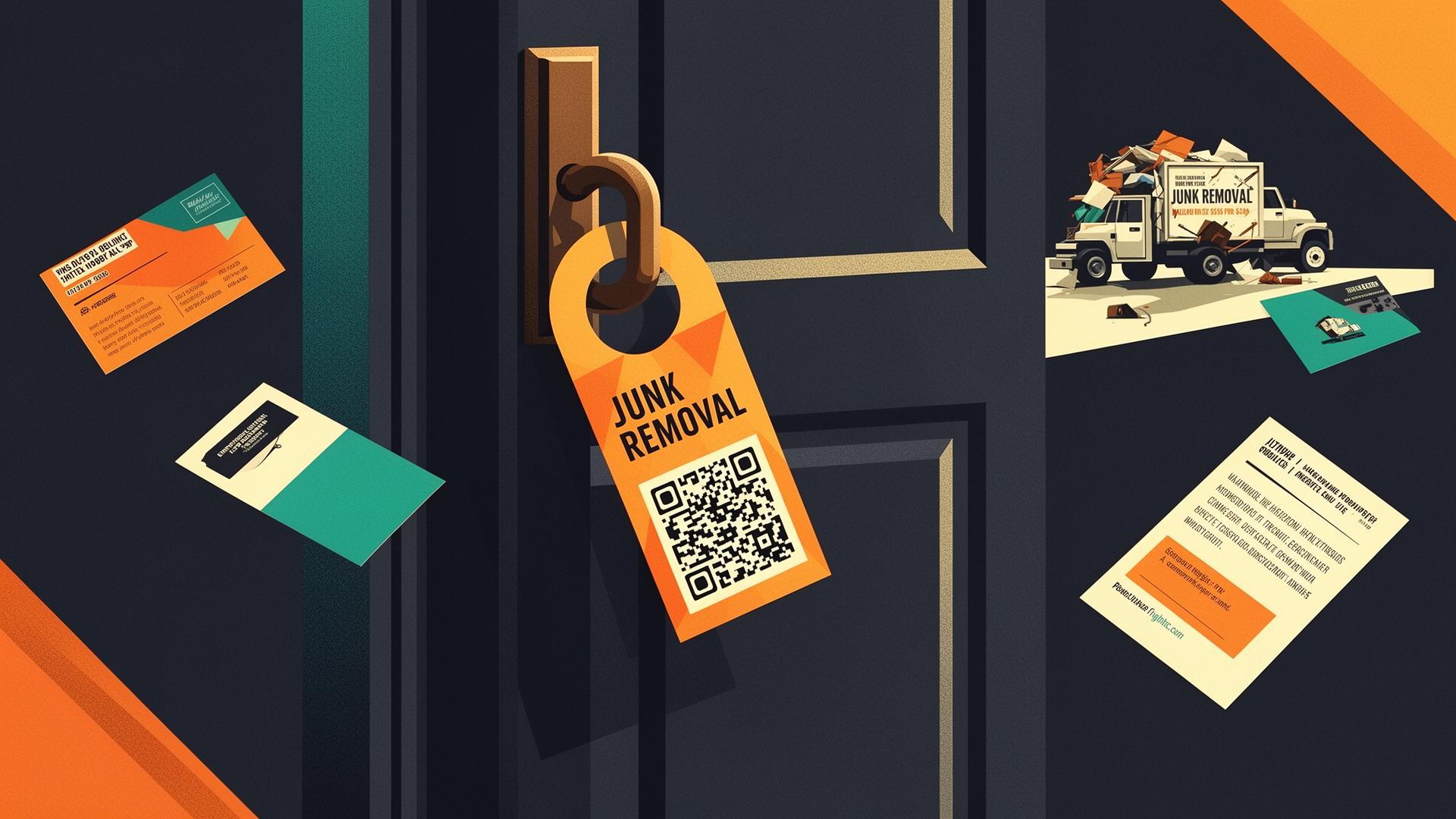
Most junk removal flyers and door hangers fail for the same three reasons: no real offer, no tracking, and no bridge from paper to digital. A printed piece without a phone-trackable number, a unique landing page, and a retargeting pixel is just litter. Done right, door hangers run at $8–$25 per booked job in suburban markets — cheaper than LSA in some neighborhoods. Here's the operator playbook with 6 layouts, real cost-per-door math, and the digital plumbing that triples response rate.
TL;DR
- • Realistic response rate: 0.3–1.2% for door hangers, 0.1–0.4% for mailed flyers.
- • Cost per booked job: $8–$25 (door hangers), $18–$45 (EDDM mailers), assuming 25% phone-to-booked conversion.
- • Every printed piece needs: a clear offer, a tracking phone number, a QR code to a campaign landing page, and a single visual proof point.
- • Target the right blocks — 25+ years old, $80K+ median income, single-family homes, recent movers. Skip apartments.
- • The flyer is a top-of-funnel asset. Most "responses" actually book by Googling you 3–14 days later — measure with branded-search lift, not just inbound calls.
Why print still works for junk removal in 2026
Junk removal is one of the few home services where the customer literally sees the problem at the front door. A door hanger catches them walking past their own garage with a pile of stuff in it. No other channel — not Google, not Meta, not Nextdoor — puts a message in front of a homeowner at the exact physical location of the buying trigger.
Print also outperforms digital on three specific job types: garage cleanouts, yard waste, and post-move cleanouts. These are neighborhood-pattern problems — one house declutters, three neighbors notice and want the same thing. Saturation hanging on a 2–3 street radius around a recent job is the single highest-ROI print play in junk removal.
6 junk removal flyer and door hanger layouts that book jobs
1. The "We just helped your neighbor" hanger
Photo of the actual truck parked on the actual street, with one line: "We just cleared a garage on [Street Name]. Need the same?" Hang on the 30–60 homes nearest a completed job, within 48 hours. Response rate: 1.5–3% — by far the highest of any print play.
2. The before/after split-card flyer
Half-page postcard, before/after photo of a real cleanout (cluttered garage → empty garage), price anchor ("Full-truck cleanouts from $399"), phone number, QR code. Works for EDDM mail and standalone drops.
3. The "10 things we'll take" checklist hanger
A bulleted list of common items (mattress, couch, fridge, hot tub, playset, treadmill, water heater, paint cans, fence panels, yard debris) with checkboxes. Triggers item-specific recognition — homeowners think "oh right, I have two of those." Response 0.8–1.5%.
4. The fridge magnet hanger
Door hanger with a perforated 2x3" magnet at the bottom that pops out and goes on the fridge. Higher print cost (~$0.45 each vs $0.18 for paper) but 6–18 month residual response — the magnet keeps generating calls long after the hang.
5. The seasonal-trigger flyer
Time the flyer to a local trigger: spring "garage cleanout season," post-holiday "Christmas tree + box pickup," fall "yard cleanup." Same base template, swap the headline and offer. Seasonal flyers outperform evergreen ones by 40–80% on response rate.
6. The realtor / property-manager co-branded flyer
Partner with a local listing agent: their photo and brand on one side, your service on the other ("Pre-listing cleanout in 24 hours — call [your number]"). They distribute through their listing clients; you handle the work. Zero print cost to you, premium ticket per booked job ($800–$3,500).
The 5 elements every junk removal flyer must have
- One specific offer. "$50 off any full-truck load" beats "great rates!" every time. Numbers convert; adjectives don't.
- A tracking phone number. Use a CallRail or WhatConverts number unique to this campaign. Without it, you have no idea if the flyer worked.
- A QR code to a campaign landing page. Don't send them to your homepage. Send them to a URL like `/garage-cleanout` that mirrors the flyer's headline. This is also how you cookie them for retargeting.
- One visual proof point. A real photo of a completed cleanout beats stock imagery and beats your logo. Stock photos kill response rate.
- An expiration date. "Offer valid through [date 21 days out]." Manufactures urgency. Response rate jumps 25–40% with a real deadline.
Cost per door, cost per call, cost per booked job
Real 2026 numbers for a single-truck operator running a 5,000-door hang in a suburban metro:
- Print cost: $0.18–$0.32 per door hanger at 5,000-quantity runs (UPrinting, GotPrint, PSPrint).
- Distribution: $0.10–$0.18 per door via a hanger service, or $0 if you/the crew hangs them on a slow day.
- Total cost per door: $0.28–$0.50.
- Expected response: 0.3–1.2% will call or scan the QR code (15–60 inbound contacts on 5,000 hangs).
- Phone-to-booked conversion: 25–40% with a competent call handler.
- Expected booked jobs: 4–24 jobs per 5,000-hang campaign.
- Total spend: $1,400–$2,500 → cost per booked job: $60–$625 wildly variable. The "We just helped your neighbor" tactic on tight 60-home drops gets you to the $8–$25 floor; broad cold drops sit at the high end.
Compare that to LSA at $35–$80 and Google Search at $90–$180. Print only beats digital when you nail targeting and follow-up.
Who to hang (and who to skip)
The 5,000-door blanket hang is a beginner mistake. Target like a direct-mail pro instead:
- Single-family homes only. Apartments and condos almost never book junk removal — wrong tenure, wrong decision-maker.
- $80K+ median household income zip codes. Below that, price-shopping kills your margin.
- 15+ year old housing stock. Newer subdivisions don't have accumulation yet.
- Recent movers within 90 days. NextMark, Cole, or USPS New Mover lists. Highest-converting list type in junk removal.
- 2–3 block radius around recent jobs. The "neighbor" play above.
- Skip: downtown apartments, college student housing, gated 55+ communities (HOA often has a removal contract already).
The digital bridge that triples response
70–85% of flyer "responses" don't actually call the number on the flyer. They Google you 3–14 days later. If your digital plumbing isn't ready, those leads quietly go to LSA or competitors.
- Campaign landing page at a clean URL (`/garage-cleanout`). Single H1 matching the flyer, click-to-call button, 3 photos, 30-second load.
- Meta Pixel + Google Ads tag on that page, with a 30-day retargeting audience. Every QR scan becomes a Facebook retargeting impression for the next month.
- Branded-search budget bump. Add 30% to your Google Search budget on your brand name keyword during the 2 weeks after distribution — that's where the residual response shows up.
- Call tracking everywhere — unique number on the flyer, a different unique number on the landing page. Now you can see how many leads came direct vs through Google.
This is also the bridge from "we tried flyers, didn't work" to "we tied $4,200 of revenue back to one hang campaign." Without the bridge, the offline channel always looks worse than it is.
10 junk removal advertising ideas beyond the basic hanger
- Truck wrap as a moving billboard. $2,500–$5,500 one-time, 5+ year life, 30,000–60,000 daily impressions in a mid-size metro.
- Yard signs at completed jobs ("Cleared by [you] — call XXX-XXX") with property owner permission. $4 per sign.
- HOA newsletter sponsorship — $50–$200/mo per HOA, hyper-targeted to single-family homes.
- Estate sale partnership — they sell, you haul what doesn't sell. 100% conversion on every estate sale.
- Storage facility magnet — leave fridge magnets at every storage facility front desk.
- Apartment leasing-office flyer stand — for move-out cleanouts.
- Self-storage lien-sale partnerships (see our commercial contracts guide).
- Local moving company referral. 10% kickback for every cleanout they refer.
- Charity tie-in — donate one cleanout per month, photograph it, post and flyer it.
- "Pile pickup" sign at the curb on busy roads with permission of the property owner — best lead-gen sign in the business.
When print is worth it (and when it's not)
Run flyers and door hangers when: you're in a suburban or rural market (population density 800–3,000/sq mi), your residential ad CPL has crossed $100, you have a slow day on the truck you can use for distribution, or you just completed a notable job and want to saturate the neighborhood.
Skip print when: you're in a dense urban market (the math doesn't work), you don't yet have call tracking and a landing page set up, or your fundamentals (LSA + Google Search) aren't dialed in. Print is a layer on top of digital, not a substitute. The full picture of how it fits into your junk removal Google Ads playbook lives in our 5-channel playbook.
Ready to start?
Flyers build awareness. Google Ads catch the demand.
The people who kept your hanger call later — usually after searching "junk removal near me." We run Google Ads and Local Services Ads for junk removal companies only, so that search lands on you. Send us your account for a written audit. Plans from $499/mo.
Choose your plan →Sources
Frequently asked questions
- Do flyers and door hangers actually work for junk removal?
- Yes, but only when wired to a landing page, call tracking number, and retargeting pixel. Realistic response rate is 0.3–1.2% for door hangers and 0.1–0.4% for mailed flyers. Cost per booked job runs $8–$25 for door hangers and $18–$45 for EDDM mailers (assuming 25–40% phone-to-booked conversion). The single highest-ROI play — saturation hanging on 30–60 homes near a completed job within 48 hours — converts at 1.5–3% because of neighborhood social proof.
- What should a junk removal flyer say?
- Five elements are non-negotiable: (1) one specific offer with a number ("$50 off any full-truck load" beats "great rates"), (2) a unique tracking phone number — never your main line, (3) a QR code to a campaign landing page that mirrors the flyer headline, (4) one real photo of a completed cleanout (no stock images, no AI), (5) an expiration date 21 days out for urgency. Skip your logo as the hero — the offer is the hero.
- How much does junk removal flyer printing and distribution cost?
- At a 5,000-quantity run from UPrinting, GotPrint, or PSPrint: $0.18–$0.32 per door hanger printed, plus $0.10–$0.18 per door for a hanger distribution service (free if your crew hangs them on a slow day). Total per-door cost lands at $0.28–$0.50. A typical 5,000-hang campaign costs $1,400–$2,500 and produces 4–24 booked jobs depending on targeting quality.
- Where should I hang junk removal door hangers for the best response?
- Single-family homes in $80K+ median income zip codes, in housing stock that's 15+ years old (older homes have more accumulated stuff). Skip apartments, condos, college housing, and gated 55+ communities. The highest-converting list type is recent movers within 90 days (NextMark, Cole, or USPS New Mover lists). The single best tactic is the 2–3 block radius around a completed job — saturation hanging within 48 hours of doing visible work in the neighborhood.
- What junk removal advertising ideas work besides flyers?
- Truck wraps ($2,500–$5,500, 5+ year life, 30K–60K daily impressions in a mid-size metro), yard signs at completed jobs ($4 each), HOA newsletter sponsorships ($50–$200/mo), estate-sale partnerships, storage-facility fridge magnets, apartment leasing-office flyer stands, self-storage lien-sale partnerships, local moving-company referral kickbacks, charity-tie-in cleanouts, and curbside "pile pickup" signs on busy roads. The pattern that works: hyper-local, visible at the moment of need, with a trackable response path.
Keep reading
Junk Removal Marketing: The 2026 Playbook to Fill Your Trucks Without Wasting Ad Spend
A no-fluff playbook on the five marketing channels that actually book junk removal jobs in 2026 — what to spend, what to skip, and how to track real cost-per-job.
Junk Removal Leads: How to Generate Booked-Job Leads in 2026
The 6 lead channels that actually book junk removal jobs in 2026 — cost per booked job, speed-to-lead, qualification scripts, CRM tracking, and how to scale from 30 to 300 leads/mo.
Google Ads for Junk Removal: The 2026 PPC Playbook to Fill Trucks at Sub-$50 CPL
Campaign structure, negative keywords, bid strategy, landing pages, and conversion tracking that keep junk removal Google Ads accounts profitable in 2026.